/** * Shared empty array instance used for empty instances. */ privatestaticfinal Object[] EMPTY_ELEMENTDATA = {};
/** * Shared empty array instance used for default sized empty instances. We * distinguish this from EMPTY_ELEMENTDATA to know how much to inflate when * first element is added. */ privatestaticfinal Object[] DEFAULTCAPACITY_EMPTY_ELEMENTDATA = {};
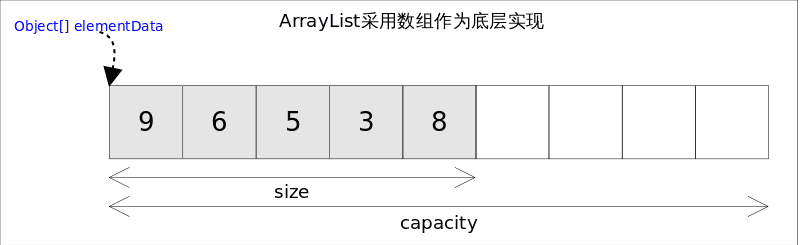
/** * The array buffer into which the elements of the ArrayList are stored. * The capacity of the ArrayList is the length of this array buffer. Any * empty ArrayList with elementData == DEFAULTCAPACITY_EMPTY_ELEMENTDATA * will be expanded to DEFAULT_CAPACITY when the first element is added. */ transient Object[] elementData; // non-private to simplify nested class access
/** * The size of the ArrayList (the number of elements it contains). * * @serial */ privateint size;
/** * Constructs an empty list with the specified initial capacity. * * @param initialCapacity the initial capacity of the list * @throws IllegalArgumentException if the specified initial capacity * is negative */ publicArrayList(int initialCapacity) { if (initialCapacity > 0) { this.elementData = newObject[initialCapacity]; } elseif (initialCapacity == 0) { this.elementData = EMPTY_ELEMENTDATA; } else { thrownewIllegalArgumentException("Illegal Capacity: "+ initialCapacity); } }
/** * Constructs an empty list with an initial capacity of ten. */ publicArrayList() { this.elementData = DEFAULTCAPACITY_EMPTY_ELEMENTDATA; }
/** * Constructs a list containing the elements of the specified * collection, in the order they are returned by the collection's * iterator. * * @param c the collection whose elements are to be placed into this list * @throws NullPointerException if the specified collection is null */ publicArrayList(Collection<? extends E> c) { Object[] a = c.toArray(); if ((size = a.length) != 0) { if (c.getClass() == ArrayList.class) { elementData = a; } else { elementData = Arrays.copyOf(a, size, Object[].class); } } else { // replace with empty array. elementData = EMPTY_ELEMENTDATA; } }
/** * Trims the capacity of this <tt>ArrayList</tt> instance to be the * list's current size. An application can use this operation to minimize * the storage of an <tt>ArrayList</tt> instance. */ publicvoidtrimToSize() { modCount++; if (size < elementData.length) { elementData = (size == 0) ? EMPTY_ELEMENTDATA : Arrays.copyOf(elementData, size); } }
/** * Increases the capacity of this <tt>ArrayList</tt> instance, if * necessary, to ensure that it can hold at least the number of elements * specified by the minimum capacity argument. * * @param minCapacity the desired minimum capacity */ publicvoidensureCapacity(int minCapacity) { intminExpand= (elementData != DEFAULTCAPACITY_EMPTY_ELEMENTDATA) // any size if not default element table ? 0 // larger than default for default empty table. It's already // supposed to be at default size. : DEFAULT_CAPACITY;
if (minCapacity > minExpand) { ensureExplicitCapacity(minCapacity); } }
privatestaticintcalculateCapacity(Object[] elementData, int minCapacity) { if (elementData == DEFAULTCAPACITY_EMPTY_ELEMENTDATA) { return Math.max(DEFAULT_CAPACITY, minCapacity); } return minCapacity; }
/** * The maximum size of array to allocate. * Some VMs reserve some header words in an array. * Attempts to allocate larger arrays may result in * OutOfMemoryError: Requested array size exceeds VM limit */ privatestaticfinalintMAX_ARRAY_SIZE= Integer.MAX_VALUE - 8;
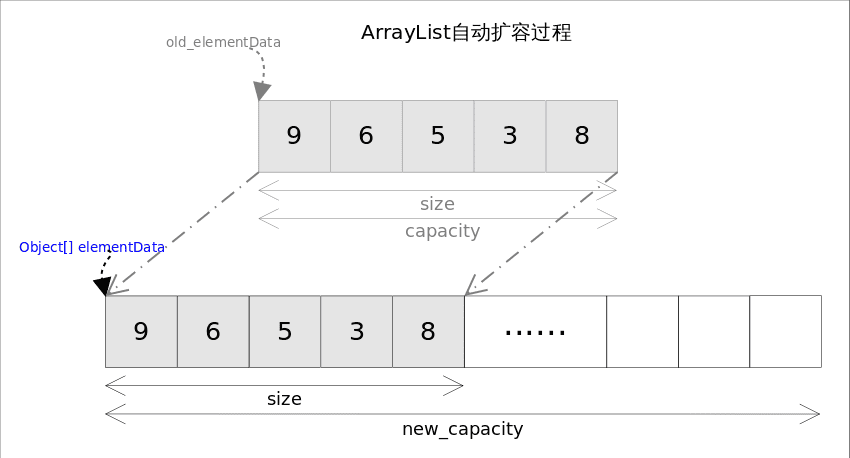
/** * Increases the capacity to ensure that it can hold at least the * number of elements specified by the minimum capacity argument. * * @param minCapacity the desired minimum capacity */ privatevoidgrow(int minCapacity) { // overflow-conscious code intoldCapacity= elementData.length; intnewCapacity= oldCapacity + (oldCapacity >> 1); if (newCapacity - minCapacity < 0) newCapacity = minCapacity; if (newCapacity - MAX_ARRAY_SIZE > 0) newCapacity = hugeCapacity(minCapacity); // minCapacity is usually close to size, so this is a win: elementData = Arrays.copyOf(elementData, newCapacity); }
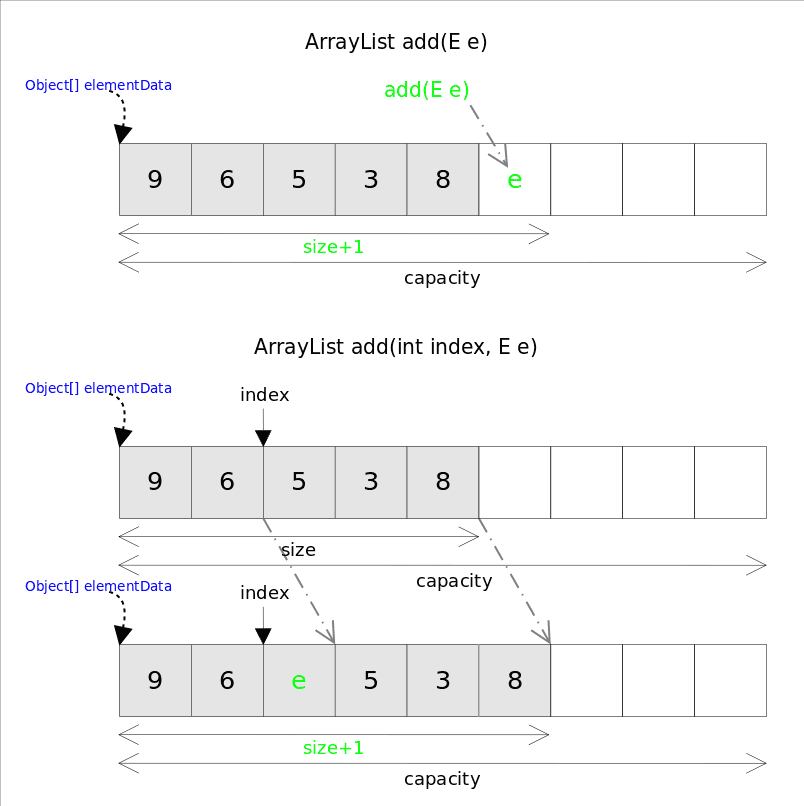
/** * Appends the specified element to the end of this list. * * @param e element to be appended to this list * @return <tt>true</tt> (as specified by {@link Collection#add}) */ publicbooleanadd(E e) { ensureCapacityInternal(size + 1); // Increments modCount!! elementData[size++] = e; returntrue; }
/** * Inserts the specified element at the specified position in this * list. Shifts the element currently at that position (if any) and * any subsequent elements to the right (adds one to their indices). * * @param index index at which the specified element is to be inserted * @param element element to be inserted * @throws IndexOutOfBoundsException {@inheritDoc} */ publicvoidadd(int index, E element) { rangeCheckForAdd(index);
/** * Appends all of the elements in the specified collection to the end of * this list, in the order that they are returned by the * specified collection's Iterator. The behavior of this operation is * undefined if the specified collection is modified while the operation * is in progress. (This implies that the behavior of this call is * undefined if the specified collection is this list, and this * list is nonempty.) * * @param c collection containing elements to be added to this list * @return <tt>true</tt> if this list changed as a result of the call * @throws NullPointerException if the specified collection is null */ publicbooleanaddAll(Collection<? extends E> c) { Object[] a = c.toArray(); intnumNew= a.length; ensureCapacityInternal(size + numNew); // Increments modCount System.arraycopy(a, 0, elementData, size, numNew); size += numNew; return numNew != 0; }
/** * Inserts all of the elements in the specified collection into this * list, starting at the specified position. Shifts the element * currently at that position (if any) and any subsequent elements to * the right (increases their indices). The new elements will appear * in the list in the order that they are returned by the * specified collection's iterator. * * @param index index at which to insert the first element from the * specified collection * @param c collection containing elements to be added to this list * @return <tt>true</tt> if this list changed as a result of the call * @throws IndexOutOfBoundsException {@inheritDoc} * @throws NullPointerException if the specified collection is null */ publicbooleanaddAll(int index, Collection<? extends E> c) { rangeCheckForAdd(index);
/** * Replaces the element at the specified position in this list with * the specified element. * * @param index index of the element to replace * @param element element to be stored at the specified position * @return the element previously at the specified position * @throws IndexOutOfBoundsException {@inheritDoc} */ public E set(int index, E element) { rangeCheck(index);
/** * Checks if the given index is in range. If not, throws an appropriate * runtime exception. This method does *not* check if the index is * negative: It is always used immediately prior to an array access, * which throws an ArrayIndexOutOfBoundsException if index is negative. */ privatevoidrangeCheck(int index) { if (index >= size) thrownewIndexOutOfBoundsException(outOfBoundsMsg(index)); }
@SuppressWarnings("unchecked") E elementData(int index) { return (E) elementData[index]; }
get
1
2
3
4
5
6
7
8
9
10
11
12
/** * Returns the element at the specified position in this list. * * @param index index of the element to return * @return the element at the specified position in this list * @throws IndexOutOfBoundsException {@inheritDoc} */ public E get(int index) { rangeCheck(index);
/** * Removes the element at the specified position in this list. * Shifts any subsequent elements to the left (subtracts one from their * indices). * * @param index the index of the element to be removed * @return the element that was removed from the list * @throws IndexOutOfBoundsException {@inheritDoc} */ public E remove(int index) { rangeCheck(index);
modCount++; EoldValue= elementData(index);
intnumMoved= size - index - 1; if (numMoved > 0) System.arraycopy(elementData, index+1, elementData, index, numMoved); elementData[--size] = null; // clear to let GC do its work
return oldValue; }
/** * Removes the first occurrence of the specified element from this list, * if it is present. If the list does not contain the element, it is * unchanged. More formally, removes the element with the lowest index * <tt>i</tt> such that * <tt>(o==null ? get(i)==null : o.equals(get(i)))</tt> * (if such an element exists). Returns <tt>true</tt> if this list * contained the specified element (or equivalently, if this list * changed as a result of the call). * * @param o element to be removed from this list, if present * @return <tt>true</tt> if this list contained the specified element */ publicbooleanremove(Object o) { if (o == null) { for (intindex=0; index < size; index++) if (elementData[index] == null) { fastRemove(index); returntrue; } } else { for (intindex=0; index < size; index++) if (o.equals(elementData[index])) { fastRemove(index); returntrue; } } returnfalse; }
/** * Returns the index of the first occurrence of the specified element * in this list, or -1 if this list does not contain the element. * More formally, returns the lowest index <tt>i</tt> such that * <tt>(o==null ? get(i)==null : o.equals(get(i)))</tt>, * or -1 if there is no such index. */ publicintindexOf(Object o) { if (o == null) { for (inti=0; i < size; i++) if (elementData[i]==null) return i; } else { for (inti=0; i < size; i++) if (o.equals(elementData[i])) return i; } return -1; }
/** * Returns the index of the last occurrence of the specified element * in this list, or -1 if this list does not contain the element. * More formally, returns the highest index <tt>i</tt> such that * <tt>(o==null ? get(i)==null : o.equals(get(i)))</tt>, * or -1 if there is no such index. */ publicintlastIndexOf(Object o) { if (o == null) { for (inti= size-1; i >= 0; i--) if (elementData[i]==null) return i; } else { for (inti= size-1; i >= 0; i--) if (o.equals(elementData[i])) return i; } return -1; }
/** * The number of times this list has been <i>structurally modified</i>. * Structural modifications are those that change the size of the * list, or otherwise perturb it in such a fashion that iterations in * progress may yield incorrect results. * * <p>This field is used by the iterator and list iterator implementation * returned by the {@code iterator} and {@code listIterator} methods. * If the value of this field changes unexpectedly, the iterator (or list * iterator) will throw a {@code ConcurrentModificationException} in * response to the {@code next}, {@code remove}, {@code previous}, * {@code set} or {@code add} operations. This provides * <i>fail-fast</i> behavior, rather than non-deterministic behavior in * the face of concurrent modification during iteration. * * <p><b>Use of this field by subclasses is optional.</b> If a subclass * wishes to provide fail-fast iterators (and list iterators), then it * merely has to increment this field in its {@code add(int, E)} and * {@code remove(int)} methods (and any other methods that it overrides * that result in structural modifications to the list). A single call to * {@code add(int, E)} or {@code remove(int)} must add no more than * one to this field, or the iterators (and list iterators) will throw * bogus {@code ConcurrentModificationExceptions}. If an implementation * does not wish to provide fail-fast iterators, this field may be * ignored. */ protectedtransientintmodCount=0;
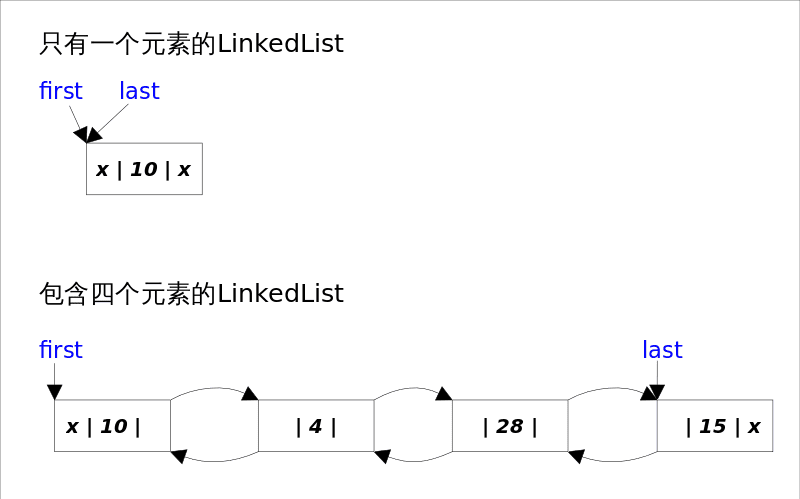
/** * Constructs an empty list. */ publicLinkedList() { }
/** * Constructs a list containing the elements of the specified * collection, in the order they are returned by the collection's * iterator. * * @param c the collection whose elements are to be placed into this list * @throws NullPointerException if the specified collection is null */ publicLinkedList(Collection<? extends E> c) { this(); addAll(c); }
/** * Returns the first element in this list. * * @return the first element in this list * @throws NoSuchElementException if this list is empty */ public E getFirst() { final Node<E> f = first; if (f == null) thrownewNoSuchElementException(); return f.item; }
/** * Returns the last element in this list. * * @return the last element in this list * @throws NoSuchElementException if this list is empty */ public E getLast() { final Node<E> l = last; if (l == null) thrownewNoSuchElementException(); return l.item; }
/** * Removes and returns the first element from this list. * * @return the first element from this list * @throws NoSuchElementException if this list is empty */ public E removeFirst() { final Node<E> f = first; if (f == null) thrownewNoSuchElementException(); return unlinkFirst(f); }
/** * Unlinks non-null first node f. */ private E unlinkFirst(Node<E> f) { // assert f == first && f != null; finalEelement= f.item; final Node<E> next = f.next; f.item = null; f.next = null; // help GC first = next; if (next == null) last = null; else next.prev = null; size--; modCount++; return element; }
/** * Removes and returns the last element from this list. * * @return the last element from this list * @throws NoSuchElementException if this list is empty */ public E removeLast() { final Node<E> l = last; if (l == null) thrownewNoSuchElementException(); return unlinkLast(l); }
/** * Unlinks non-null last node l. */ private E unlinkLast(Node<E> l) { // assert l == last && l != null; finalEelement= l.item; final Node<E> prev = l.prev; l.item = null; l.prev = null; // help GC last = prev; if (prev == null) first = null; else prev.next = null; size--; modCount++; return element; }
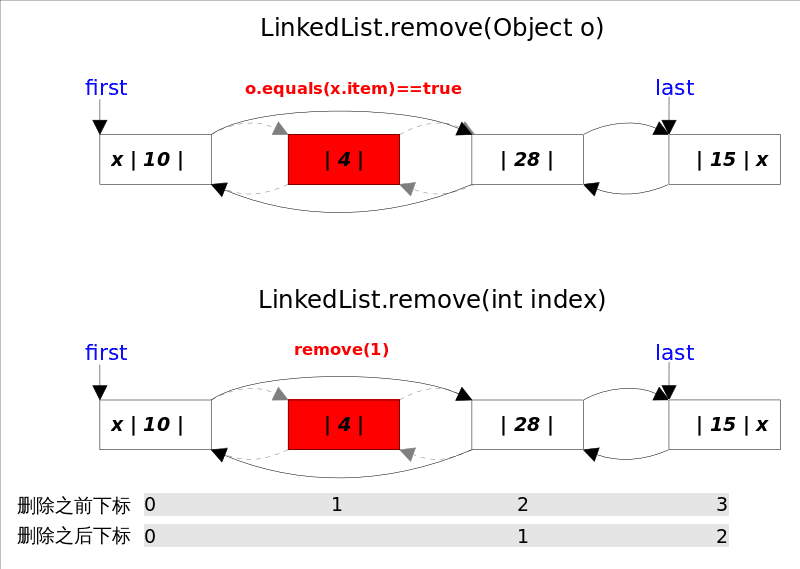
/** * Removes the first occurrence of the specified element from this list, * if it is present. If this list does not contain the element, it is * unchanged. More formally, removes the element with the lowest index * {@code i} such that * <tt>(o==null ? get(i)==null : o.equals(get(i)))</tt> * (if such an element exists). Returns {@code true} if this list * contained the specified element (or equivalently, if this list * changed as a result of the call). * * @param o element to be removed from this list, if present * @return {@code true} if this list contained the specified element */ publicbooleanremove(Object o) { if (o == null) { for (Node<E> x = first; x != null; x = x.next) { if (x.item == null) { unlink(x); returntrue; } } } else { for (Node<E> x = first; x != null; x = x.next) { if (o.equals(x.item)) { unlink(x); returntrue; } } } returnfalse; }
/** * Removes the element at the specified position in this list. Shifts any * subsequent elements to the left (subtracts one from their indices). * Returns the element that was removed from the list. * * @param index the index of the element to be removed * @return the element previously at the specified position * @throws IndexOutOfBoundsException {@inheritDoc} */ public E remove(int index) { checkElementIndex(index); return unlink(node(index)); }
/** * Unlinks non-null node x. */ E unlink(Node<E> x) { // assert x != null; finalEelement= x.item; final Node<E> next = x.next; final Node<E> prev = x.prev;
if (prev == null) { first = next; } else { prev.next = next; x.prev = null; }
if (next == null) { last = prev; } else { next.prev = prev; x.next = null; }
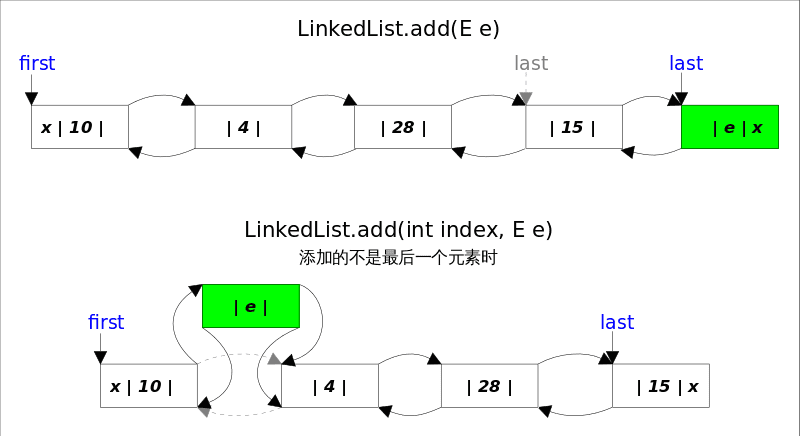
/** * Appends the specified element to the end of this list. * * <p>This method is equivalent to {@link #addLast}. * * @param e element to be appended to this list * @return {@code true} (as specified by {@link Collection#add}) */ publicbooleanadd(E e) { linkLast(e); returntrue; }
/** * Links e as last element. */ voidlinkLast(E e) { final Node<E> l = last; final Node<E> newNode = newNode<>(l, e, null); last = newNode; if (l == null) first = newNode; else l.next = newNode; size++; modCount++; }
/** * Inserts the specified element at the specified position in this list. * Shifts the element currently at that position (if any) and any * subsequent elements to the right (adds one to their indices). * * @param index index at which the specified element is to be inserted * @param element element to be inserted * @throws IndexOutOfBoundsException {@inheritDoc} */ publicvoidadd(int index, E element) { checkPositionIndex(index);
if (index == size) linkLast(element); else linkBefore(element, node(index)); }
/** * Inserts element e before non-null Node succ. */ voidlinkBefore(E e, Node<E> succ) { // assert succ != null; final Node<E> pred = succ.prev; final Node<E> newNode = newNode<>(pred, e, succ); succ.prev = newNode; if (pred == null) first = newNode; else pred.next = newNode; size++; modCount++; }
privatevoidcheckPositionIndex(int index) { if (!isPositionIndex(index)) thrownewIndexOutOfBoundsException(outOfBoundsMsg(index)); }
/** * Returns the (non-null) Node at the specified element index. */ Node<E> node(int index) { // assert isElementIndex(index);
if (index < (size >> 1)) { Node<E> x = first; for (inti=0; i < index; i++) x = x.next; return x; } else { Node<E> x = last; for (inti= size - 1; i > index; i--) x = x.prev; return x; } }
/** * Appends all of the elements in the specified collection to the end of * this list, in the order that they are returned by the specified * collection's iterator. The behavior of this operation is undefined if * the specified collection is modified while the operation is in * progress. (Note that this will occur if the specified collection is * this list, and it's nonempty.) * * @param c collection containing elements to be added to this list * @return {@code true} if this list changed as a result of the call * @throws NullPointerException if the specified collection is null */ publicbooleanaddAll(Collection<? extends E> c) { return addAll(size, c); } /** * Inserts all of the elements in the specified collection into this * list, starting at the specified position. Shifts the element * currently at that position (if any) and any subsequent elements to * the right (increases their indices). The new elements will appear * in the list in the order that they are returned by the * specified collection's iterator. * * @param index index at which to insert the first element * from the specified collection * @param c collection containing elements to be added to this list * @return {@code true} if this list changed as a result of the call * @throws IndexOutOfBoundsException {@inheritDoc} * @throws NullPointerException if the specified collection is null */ publicbooleanaddAll(int index, Collection<? extends E> c) { checkPositionIndex(index);
Object[] a = c.toArray(); intnumNew= a.length; if (numNew == 0) returnfalse;
Node<E> pred, succ; if (index == size) { succ = null; pred = last; } else { succ = node(index); pred = succ.prev; }
for (Object o : a) { @SuppressWarnings("unchecked")Ee= (E) o; Node<E> newNode = newNode<>(pred, e, null); if (pred == null) first = newNode; else pred.next = newNode; pred = newNode; }
if (succ == null) { last = pred; } else { pred.next = succ; succ.prev = pred; }
/** * Removes all of the elements from this list. * The list will be empty after this call returns. */ publicvoidclear() { // Clearing all of the links between nodes is "unnecessary", but: // - helps a generational GC if the discarded nodes inhabit // more than one generation // - is sure to free memory even if there is a reachable Iterator for (Node<E> x = first; x != null; ) { Node<E> next = x.next; x.item = null; x.next = null; x.prev = null; x = next; } first = last = null; size = 0; modCount++; }
/** * Returns the element at the specified position in this list. * * @param index index of the element to return * @return the element at the specified position in this list * @throws IndexOutOfBoundsException {@inheritDoc} */ public E get(int index) { checkElementIndex(index); return node(index).item; } /** * Replaces the element at the specified position in this list with the * specified element. * * @param index index of the element to replace * @param element element to be stored at the specified position * @return the element previously at the specified position * @throws IndexOutOfBoundsException {@inheritDoc} */ public E set(int index, E element) { checkElementIndex(index); Node<E> x = node(index); EoldVal= x.item; x.item = element; return oldVal; }
/** * Returns the index of the first occurrence of the specified element * in this list, or -1 if this list does not contain the element. * More formally, returns the lowest index {@code i} such that * <tt>(o==null ? get(i)==null : o.equals(get(i)))</tt>, * or -1 if there is no such index. * * @param o element to search for * @return the index of the first occurrence of the specified element in * this list, or -1 if this list does not contain the element */ publicintindexOf(Object o) { intindex=0; if (o == null) { for (Node<E> x = first; x != null; x = x.next) { if (x.item == null) return index; index++; } } else { for (Node<E> x = first; x != null; x = x.next) { if (o.equals(x.item)) return index; index++; } } return -1; }
/** * Returns the index of the last occurrence of the specified element * in this list, or -1 if this list does not contain the element. * More formally, returns the highest index {@code i} such that * <tt>(o==null ? get(i)==null : o.equals(get(i)))</tt>, * or -1 if there is no such index. * * @param o element to search for * @return the index of the last occurrence of the specified element in * this list, or -1 if this list does not contain the element */ publicintlastIndexOf(Object o) { intindex= size; if (o == null) { for (Node<E> x = last; x != null; x = x.prev) { index--; if (x.item == null) return index; } } else { for (Node<E> x = last; x != null; x = x.prev) { index--; if (o.equals(x.item)) return index; } } return -1; }
publicintfindMaxConsecutiveOnes(int[] nums) { intmax=0, cur = 0; for (int x : nums) { cur = x == 0 ? 0 : cur + 1; max = Math.max(max, cur); } return max; }